Digital Stoicism: A Practical System for Reclaiming Your Attention
By Eric, Founder of ReppingAlpha | Last updated August 7, 2026
The modern attention problem is not simply that there is “too much information.” It is that access to your attention is continuously available to systems whose objectives may have nothing to do with yours.
Digital Stoicism is the practice of bringing an old question into that environment: What is actually mine to govern here?
For Epictetus, the capacity for choice was central to self-command. Marcus Aurelius repeatedly returned his attention to present duty instead of applause, distraction, or speculation. ReppingAlpha applies that orientation to a world of alerts, feeds, inboxes, and algorithmic rewards.
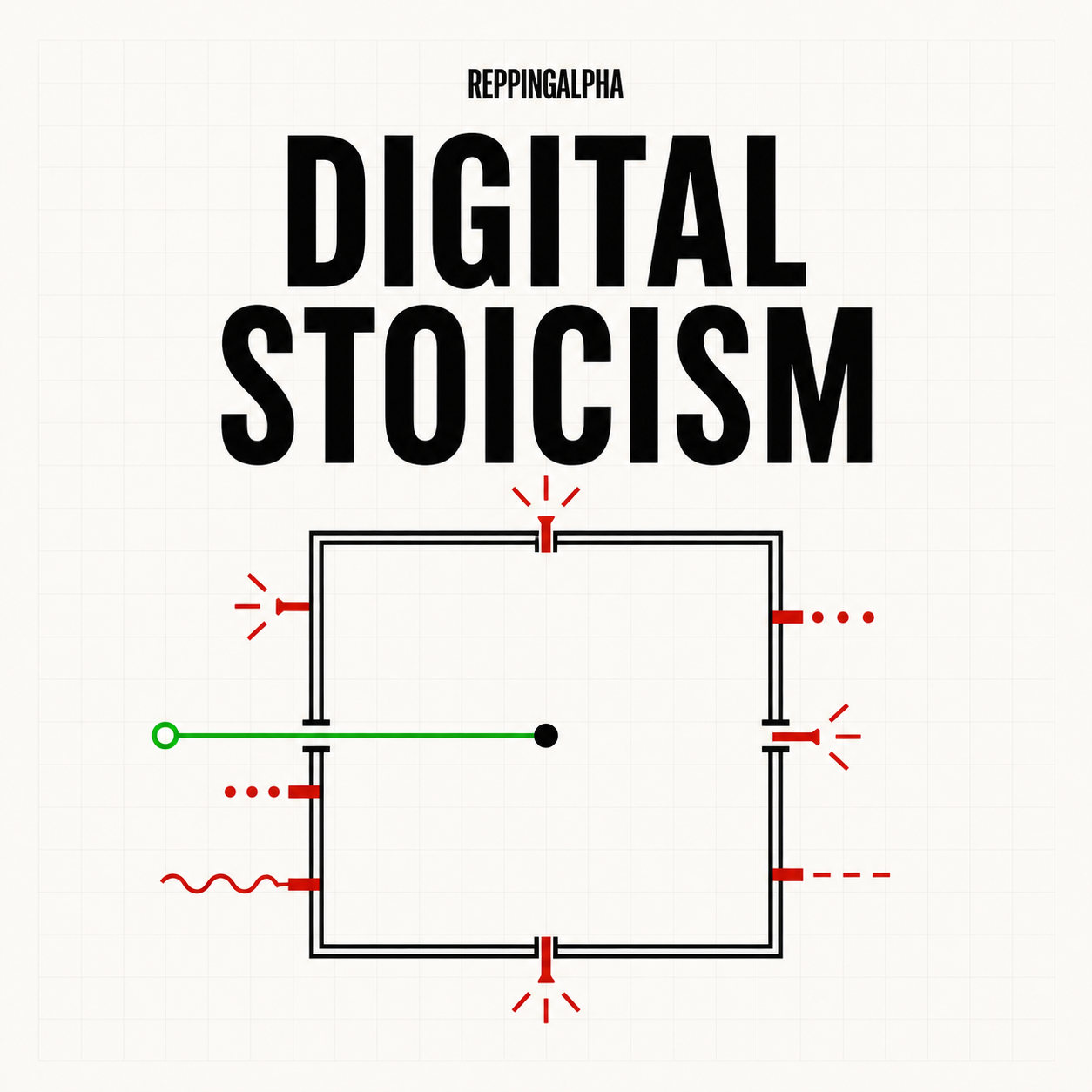
This is not about pretending a smartphone is morally bad. It is about refusing to give every input equal standing inside your operating system.
Attention Is an Allocation Decision
When an alert appears, it creates a claim: look here now. When a feed refreshes, it offers novelty without requiring a prior intention. When an inbox stays open all day, other people’s timing becomes your default sequence.
Research gives this practical concern real weight. Experimental work has found that cell-phone notifications can disrupt performance even when people do not interact with the phone, and other studies have found cumulative task interruptions can impair resumption and working-memory performance. Findings on the mere presence of a smartphone are mixed across tasks, which is a useful reminder not to exaggerate the evidence.
The ReppingAlpha conclusion is deliberately modest: reduce avoidable interruptions where focused execution matters.
The Digital Stoic Protocol
Name the Sphere of Control
You cannot control every incoming message, platform design, headline, or other person’s urgency. You can usually control more proximal decisions:
which notifications are allowed
where the phone sits during focus
when email is opened
which apps stay logged in
what time a feed becomes available
whether an impulse automatically becomes an action
Make the controllable list concrete. Philosophy becomes useful when it changes a setting, boundary, or behavior.
Separate Signal from Stimulus
Not everything that is vivid is important. Not everything that is urgent is yours.
Before opening an input, ask:
Did I choose this, or did it choose me?
Is this relevant to the outcome I am protecting?
Does it need action now, later, or never?
What would happen if I waited until the next input window?
Build an Input Boundary
Choose at least one block each day during which inputs are deliberately restricted.
Example:
From 8:30 to 10:00, the phone is outside the room, email is closed, browser tabs are limited to the project, and messages reopen at 10:00.
The power is not in the exact times. It is in changing access from continuous to intentional.
Train Return, Not Perfect Concentration
Focus is not the absence of wandering. It is the practice of noticing drift and returning without turning the lapse into a story about your character.
Try eight minutes with one target. Each time attention moves, label the distraction briefly and return. Measure returns or time-to-reentry, not the fantasy of a perfectly blank mind.
Reclaim the First Input of the Day
AlphaProtocol uses morning coherence calibration: establish your state and priority before external inputs compete to establish them for you.
Before the feed, inbox, or news:
Name your current state.
Read the outcome that matters now.
Choose the day’s primary Next Rep.
Identify the predictable distraction.
Decide the boundary that protects the first block.
Review What Captured You
At day’s end, ask two questions:
What received attention because I chose it?
What received attention because it was good at capturing it?
That difference is data for tomorrow’s environment.
Stoicism Is Not Emotional Suppression
A serious Stoic practice is not a costume of indifference. The relevant skill is deliberate assent: creating enough space between an impression and a response to examine what you are doing.
In digital life, that can be as ordinary as seeing a provocative notification and declining to let it determine the next 20 minutes of your day.
The Founder’s Version of the Problem
ReppingAlpha’s founder spent years in environments where scattered attention had consequences: first in U.S. Army Infantry service during Operation Desert Storm, later leading teams and companies through growth, fundraising, and restructuring. The modern details changed, but the underlying performance question did not: what deserves attention now, and what structure protects it?
The Stoics provide language for self-command. A modern operating system provides the repeatable conditions.
Next step: Read About ReppingAlpha for the philosophy behind the system, or explore Coherence for attention, environment, habit, energy, and recovery architecture. For the complete execution framework, read What Is a Personal Operating System and Build a Goal System That Still Works on Low-Motivation Days. https://www.reppingalpha.com/blog/build-a-goal-system-that-still-works-on-low-motivation-days
Sources: Epictetus and Stoic volition: https://plato.stanford.edu/entries/epictetus/ . Marcus Aurelius, Meditations: https://classics.mit.edu/Antoninus/meditations.4.four.html . Notification interruption experiment: https://pubmed.ncbi.nlm.nih.gov/26121498/ . Working-memory interruption research: https://pubmed.ncbi.nlm.nih.gov/36451347/ . Mixed evidence on smartphone presence: https://pubmed.ncbi.nlm.nih.gov/33137560/ and https://pubmed.ncbi.nlm.nih.gov/37291199/
This post is part of the Digital Stoicism pillar of AlphaProtocol — see the full framework for protecting the attention your goals depend on.