What Is a Personal Operating System — and What Should It Actually Do?
By Eric, Founder of ReppingAlpha | Last updated August 7, 2026
A calendar can tell you where to be. A task manager can tell you what is open. A notes app can store what you know. None of those tools can decide what deserves your finite attention.
That is the job of a personal operating system.
A useful personal operating system is the layer above individual productivity tools. It connects direction to execution, execution to feedback, and feedback to adaptation. It should help you decide what matters, translate that decision into repeatable behavior, protect the capacity needed to act, and revise the structure when reality changes.
The Seven Jobs of a Useful Personal Operating System
Establish Direction
Before optimizing activity, the system needs a definition of what matters in the current season. Otherwise efficiency simply accelerates whatever entered the queue first.
Define a small number of outcomes, the proof that would make them real, and the standards you refuse to sacrifice to obtain them.
Regulate State Before Structure
ReppingAlpha uses the chain State → Structure → Results.
When state is noisy—fatigue, threat, anger, urgency, overstimulation—you may misread priority and design the wrong plan. State regulation does not guarantee the right judgment. It improves the conditions under which judgment is made.
The practical move can be brief: pause, breathe, name the current state, separate facts from assumptions, and identify the decision in front of you.
Translate Goals Into Executable Evidence
The system should move from annual direction to a near-term objective, then to milestones, a weekly rhythm, and a daily Next Rep.
Each level should answer a different question:
Direction: What matters?
Objective: What proof should exist next?
Milestone: What must be learned, built, or decided first?
Week: What recurring blocks create that proof?
Day: What visible action happens next?
Design Behavior and Environment
Goals do not run in isolation from habits, devices, physical spaces, cues, defaults, relationships, and friction. The system should make the desired behavior easier to begin and the predictable distraction harder to access.
Protect Energy and Recovery
A schedule that ignores sleep, movement, transitions, stress, and recovery will eventually lie about its own capacity. A real operating system treats energy as infrastructure.
Create Feedback
Track leading evidence under direct control, quality signals that show how the work is being done, and lagging results that arrive later.
If the leading behavior is happening but results are not moving, the answer may be strategy or quality—not “try harder.”
Recalibrate
The system must be able to survive a new role, a family change, a health constraint, a demanding season, or a goal that no longer deserves the same capacity.
Adaptation is not inconsistency. It is how a living system remains truthful.
The ReppingAlpha Operating Cycle
AlphaProtocol expresses the system as:
Sense → Align → Structure → Execute → Circulate → Refine
Sense: notice state, energy, signal, noise, and friction.
Align: reconnect action to values, identity, and the season that matters now.
Structure: design the cues, blocks, environment, support, and measures.
Execute: complete the next evidence-producing rep.
Circulate: allow effort to return as feedback, recovery, learning, and renewed capacity.
Refine: change the system from evidence.
This cycle is intentionally above the calendar. The calendar becomes one execution surface inside it.
A Personal OS Is Not a Giant Dashboard
Complexity can become a form of avoidance. If your operating system requires an hour of administration to tell you what to do, it is consuming the capacity it was built to protect.
Start with the minimum architecture:
One current direction.
One primary 90-day proof.
One weekly leading measure.
Protected blocks.
One daily Next Rep.
One weekly review.
One explicit return protocol after disruption.
Add complexity only when it solves a repeated problem.
How to Know Whether Your System Works
Do not judge it by how impressive it looks. Judge it by behavior and evidence.
Can you name the few goals that matter?
Does the calendar reflect them?
Can you identify the next action without re-planning the whole project?
Do you know the predictable failure points?
Does the system protect recovery?
Does a missed day trigger a return instead of a collapse?
Does review change the next week?
If not, the operating system still has a job to do.
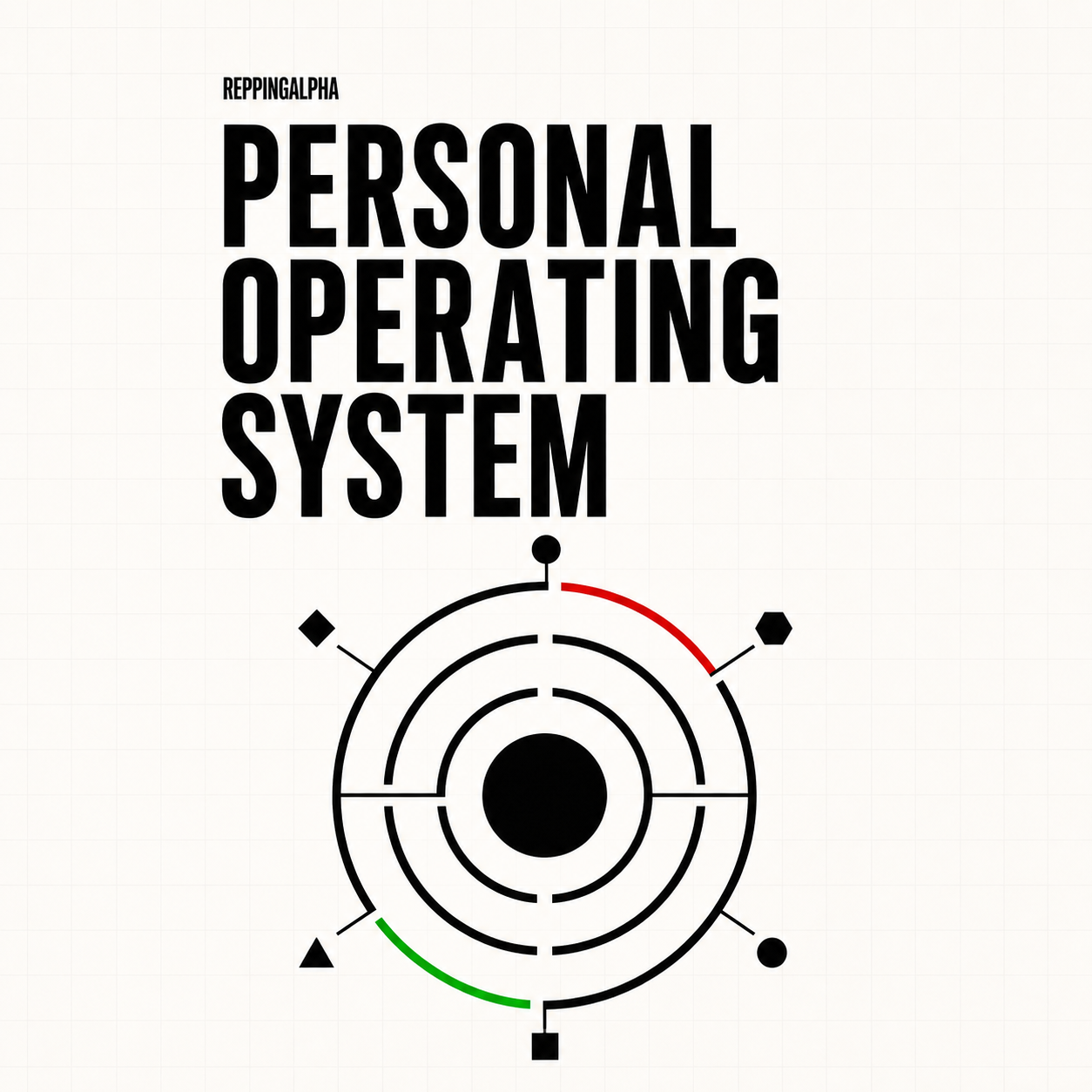
Next step: Explore AlphaProtocol, compare all three levels in the product chooser, or see Coherence for the complete self-directed personal operating system.
This post is part of the Personal Operating System pillar of AlphaProtocol — explore the full framework for building the layer above your productivity tools.