Energy and Recovery Are Execution Infrastructure, Not Rewards
By Eric, Founder of ReppingAlpha | Last updated August 7, 2026
Many plans treat recovery as what happens after the important work is finished. That reverses the relationship.
Recovery is part of the capacity that makes important work possible again.
This matters because a calendar measures hours while execution happens through a body and brain whose alertness, attention, mood, and cognitive flexibility change across the day and across weeks of accumulated demand.
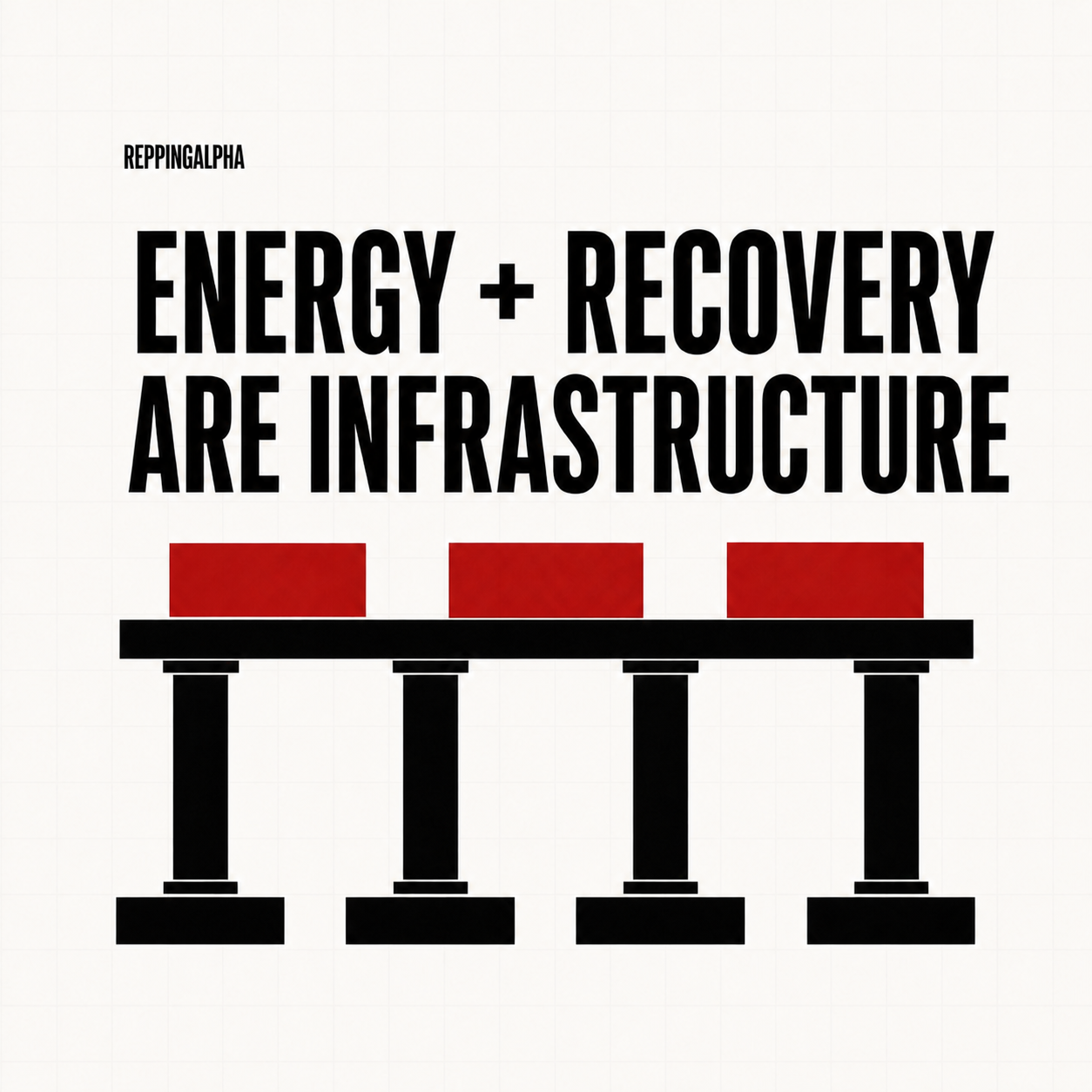
ReppingAlpha treats physiological foundations—sleep, movement, nourishment, transitions, and recovery—as infrastructure. Not because every goal is a fitness goal, but because every goal is executed through human capacity.
Time Is Not Interchangeable
An open hour at 9:00 a.m. and an open hour after a draining 12-hour day may occupy the same amount of calendar space. They do not necessarily offer the same cognitive capacity.
Instead of allocating tasks only by duration, map your common energy windows:
Peak: work requiring judgment, creation, strategy, difficult decisions.
Steady: reliable execution, meetings, structured production.
Low: routine administration, setup, cleanup, low-stakes maintenance.
Relational: conversations requiring patience and presence.
Recovery: sleep, movement, quiet, play, connection, or deliberate downshift.
The categories are personal. The principle is not.
Protect a Recovery Floor
A recovery floor is the minimum set of conditions you protect because everything else degrades when they disappear.
It may include:
a consistent sleep opportunity
regular movement appropriate to your health and circumstances
meals and hydration that do not rely on crisis timing
transition time between intense work and family or relational demands
periods without performance demands
margin in the weekly schedule
This is not medical advice or a prescription. It is capacity accounting.
Research reinforces the basic direction. Reviews of sleep deprivation find reliable effects on alertness and vigilant attention, while effects across higher-level cognitive tasks vary. A large 2025 umbrella review of randomized-trial reviews reported beneficial associations between exercise interventions and general cognition, memory, and executive function across populations, while individual exercise needs still vary.
The Depletion Diagnostic
When a goal repeatedly stalls, ask whether the failure is actually a capacity problem.
Signals can include:
work that is easy at one time of day becoming nearly impossible at another
increasing irritability around tasks that normally feel manageable
more impulsive distraction seeking
declining quality despite longer hours
recovery time disappearing from the calendar
a plan that assumes every week can run at sprint intensity
Do not make a medical conclusion from these observations. Use them as a prompt to reassess the design and, when appropriate, seek qualified health guidance.
Build Recovery Into the Operating Rhythm
Daily
Identify the transition that helps you return: a walk, a short decompression period, a device boundary, a meal, or an intentional end to work.
Weekly
Protect at least one genuine recovery block before optional work fills the space.
After Peak Demand
Do not schedule the next high-cognitive demand as though the prior one cost nothing. Build a return period proportional to the load.
During Low-Capacity Days
Use the minimum viable protocol. Preserve continuity while reducing the demand.
Recovery Is Feedback, Not Failure
The ReppingAlpha cycle includes Circulate → Refine for a reason. Effort must return as data, recovery, and renewed capacity. A system that only outputs eventually depletes the conditions that make output possible.
The disciplined move is sometimes vigorous action. Sometimes it is remission: recognizing that the next high-quality action requires restoration first. Even Marcus Aurelius’s reflections include the distinction between occasions for vigorous action and occasions for easing off.
A Simple Weekly Capacity Review
Ask:
Which energy window produced my best work?
Which demand is scheduled against the wrong window?
What is the earliest sign of depletion I noticed?
Which recovery behavior actually restored capacity?
Where did I create a zero-margin schedule?
What will I move, reduce, or protect next week?
The point is not to optimize the body into another project. It is to build a system that can keep returning.
Next step: Coherence integrates physiological foundations with goals, habits, environment, and structured review.
Sources: Sleep deprivation and attention: https://pubmed.ncbi.nlm.nih.gov/31176308/ . Sleep-loss cognition review: https://pubmed.ncbi.nlm.nih.gov/21075236/ . 2025 exercise/cognition umbrella review: https://pubmed.ncbi.nlm.nih.gov/40049759/
This post is part of the Habit Architecture pillar of AlphaProtocol — see the full framework for designing systems that account for real human capacity.