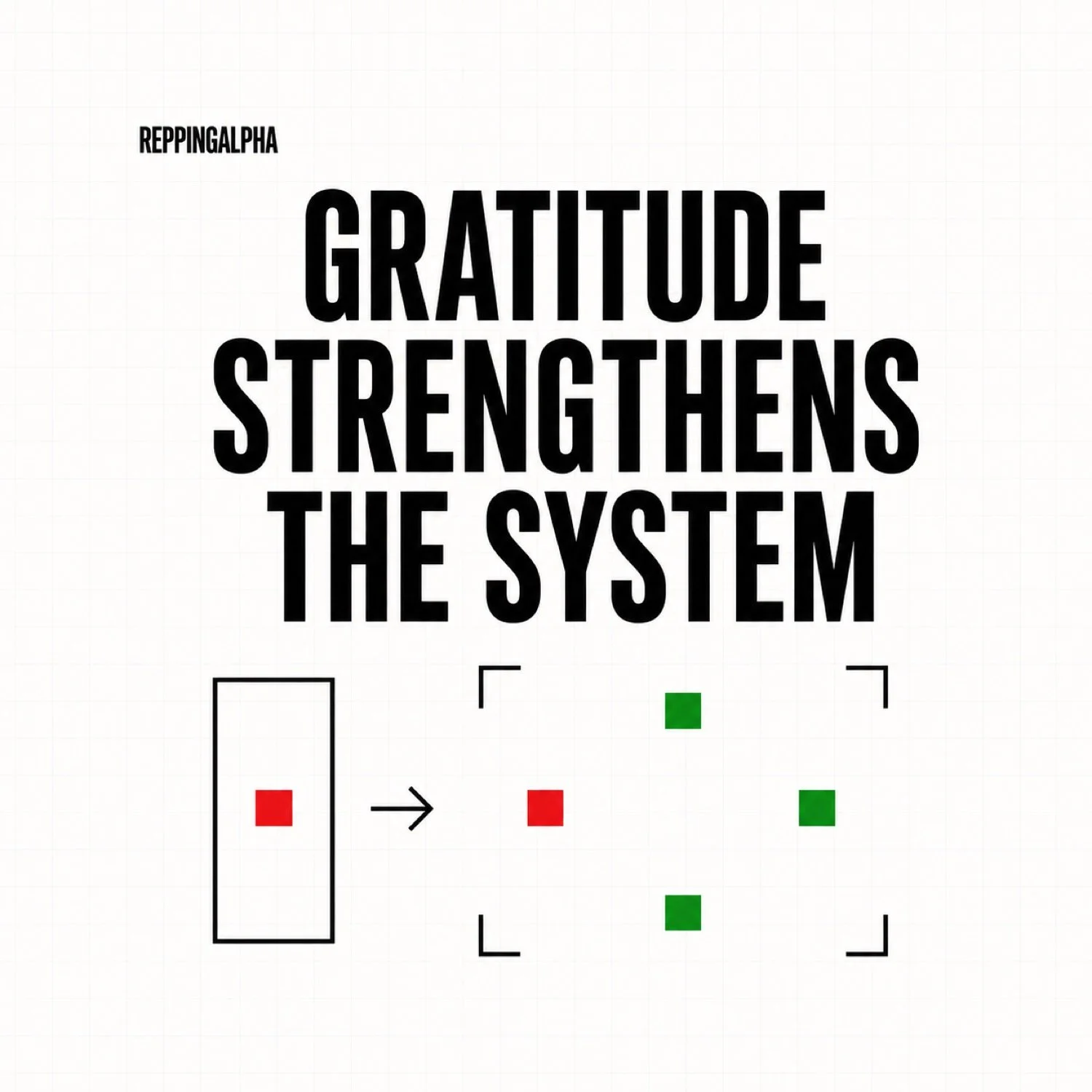
Gratitude as a System Strengthener: Useful Practice Without Forced Positivity
By Eric, Founder of ReppingAlpha | Last updated August 7, 2026
Gratitude becomes unhelpful when it is used to argue with reality.
You can be grateful and still identify a broken system. You can appreciate a person and still set a boundary. You can recognize what is good while grieving what is gone. You can be thankful for an opportunity and still decide it is wrong for you.
In ReppingAlpha, gratitude is not a command to “stay positive.” It is an attention practice: deliberately noticing sources of value that a threat- or urgency-saturated day can make easy to miss.
What Gratitude Is Doing in the System
Your operating state influences what you notice. Under sustained pressure, attention can narrow around problems, threats, errors, and unfinished work. Some of that focus is adaptive; real problems need attention. But a system that registers only threat produces an incomplete map.
A brief gratitude practice asks for additional evidence.
Not “everything is fine.”
Instead: “What was real, useful, supportive, beautiful, generous, or worth preserving today?”
That question can expand the evidence set without deleting negative evidence.
What Research Can—and Cannot—Support
Randomized and controlled studies of gratitude interventions have reported improvements in some measures of well-being and mental health, and systematic reviews generally find modest beneficial effects across varied populations and methods. That does not mean gratitude cures distress or should replace therapy, medical care, conflict resolution, or structural change.
The safest practical conclusion is narrower: a short gratitude practice can be a reasonable low-cost reflective exercise for many people.
The Three-Line Gratitude Protocol
At the end of the day, write three lines:
What I appreciated: one specific event, person, condition, opportunity, or ordinary detail.
Why it mattered: the value, need, relationship, or capacity it supported.
What I will protect or express: one action that carries the appreciation forward.
Example:
I appreciated that a colleague challenged my plan before we launched it. It mattered because honest feedback prevented avoidable rework. Tomorrow I will send a thank-you and ask her to review the first checkpoint too.
This turns gratitude from sentiment into circulation: value noticed, value interpreted, value returned.
Gratitude and the Stoic Tradition
Stoicism is sometimes caricatured as emotional austerity. Its actual ethical tradition is richer: attention to what is within one’s agency, appreciation of the present, responsibility to others, and examination of judgments.
For ReppingAlpha, the useful connection is not decorative Marcus Aurelius imagery. It is the discipline of noticing the present accurately enough to respond well.
When Not to Use Gratitude as the First Move
Do not use it to silence a legitimate signal.
If the immediate issue is danger, abuse, serious health concern, financial harm, or another high-stakes condition, appropriate action and qualified support come first. If someone tells you they are hurt, “find something to be grateful for” can become avoidance rather than wisdom.
Gratitude strengthens the system when it adds information and capacity—not when it erases evidence.
Add Gratitude to the Evening Close
Try this sequence for seven days:
What evidence moved today?
Where did I drift?
What did the drift teach me?
What am I genuinely grateful for?
What deserves repair, protection, or continuation tomorrow?
That keeps gratitude connected to honesty.
A Practical Example: Gratitude After a Difficult Day
Imagine a project failed and an important conversation went badly. A forced-positive entry might say, “I am grateful for the lesson,” before you have even identified what happened. That can become a shortcut around the evidence.
A more useful entry is:
I am grateful that the problem surfaced before we committed more time and money. That matters because we still have room to change direction. Tomorrow I will document what failed, thank the person who surfaced it, and run a review before deciding whether to continue.
Notice what the practice does: it does not call the failure good. It notices a real source of value inside a difficult condition and connects that value to responsible action.
Three Questions That Prevent Gratitude From Becoming Performance
Am I naming something specific, or writing what I think a grateful person is supposed to say?
Does this practice widen my view, or am I using it to suppress an uncomfortable fact?
What action would make the gratitude visible—thanks, protection, repair, generosity, or better stewardship?
If the answers remain honest, gratitude can strengthen attention without becoming another obligation to feel a certain way.
Next step: AlphaProtocol uses reflection, review, and recalibration to keep meaningful goals connected to ordinary days. Coherence adds gratitude and noise reduction to the full operating system.
Sources: Randomized community gratitude intervention: https://pubmed.ncbi.nlm.nih.gov/30949102/ . Systematic review and meta-analysis of gratitude interventions: https://pubmed.ncbi.nlm.nih.gov/37585888/
This post is part of the Digital Stoicism pillar of AlphaProtocol — see the full framework for practicing clear-eyed attention without forced positivity.