How to Return to Your Goal System After You Fall Off
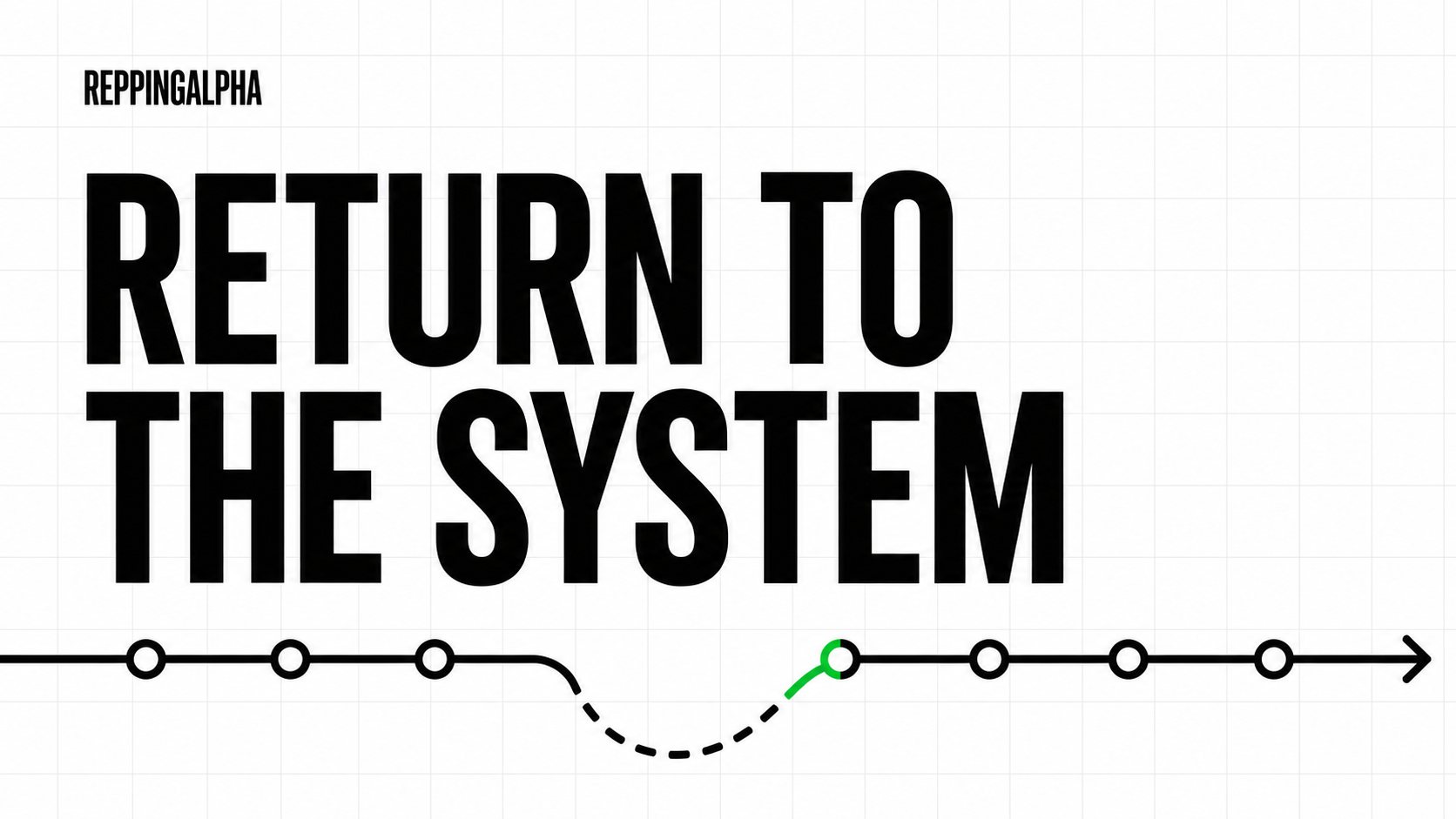
By Eric, Founder of ReppingAlpha | Last updated August 7, 2026
You did not erase your progress because the routine broke.
You discovered a condition the routine could not yet handle.
That is a more useful starting point than shame.
Step 1: Regulate before judging
Do not redesign your life in the emotional moment immediately after a miss. Pause long enough to name your current state.
Step 2: Describe the break like a camera
Bad: “I became lazy again.”
Useful: “I missed the 6:30 a.m. block three times after my work schedule moved 90 minutes later.”
Step 3: Diagnose the category
Unclear: the action or finish line is vague.
Conflict: the goal or method contradicts an important value or responsibility.
Threat: failure, visibility, rejection, success, or change feels unsafe.
Capability: skill, information, authority, or support is missing.
Friction: the environment makes delay easier than action.
Depletion: the body or emotional system needs restoration.
Different causes need different solutions.
Step 4: Choose the minimum viable return
Do not compensate for missed days with punishment. Choose the smallest action that restores continuity.
Floor is the minimum viable return: one state word, one heading, one next action. DirectedAlpha holds the heading so the return is connected to a current edge instead of a blank restart. See DirectedAlpha →
Step 5: Change one design variable
Move the block. Reduce the starting step. Prepare the environment. Add support. Remove a competing commitment. Protect recovery. Clarify the proof.
One change at a time gives you something to learn from.
Step 6: Put the return on the calendar
“Tomorrow” is not a scheduled event. Give the next action a time, place, and visible finish line.
A reset example
You planned to write from 7:00–8:00 p.m. four nights a week. After a work change, you have missed two weeks.
The old conclusion: “I lost discipline.”
The better diagnosis: low evening capacity + an unrealistic frequency.
The redesign: Tuesday and Saturday morning blocks, 45 minutes each, with a 15-minute minimum viable version during difficult weeks.
Now you have a testable system change.
The real skill is return
Perfect consistency is fragile because real life changes. A durable system contains a return protocol.
ReppingAlpha calls this recalibration. The aim is not to remain loyal to a plan that no longer fits. It is to remain loyal to deliberate execution by continuously improving the plan.
Do not make these reset mistakes
Doubling the workload
Trying to “make up” every missed action can turn one disruption into an impossible restart. Restore the rhythm first.
Returning to the exact same conditions
If nothing in the system changes, the same failure point may simply repeat. Change at least one relevant variable when the evidence supports it.
Treating every feeling as a command
Discomfort may be a normal part of doing meaningful work. It may also signal depletion, conflict, threat, or misalignment. Diagnose before obeying or overpowering it.
Waiting for a clean date
Monday, the first of the month, and January 1 are psychologically attractive but operationally unnecessary. A system can return at the next deliberate cue.
The 24-hour reset card
Write one line for each:
What changed?
What remains important?
What is the smallest useful return?
What one condition will I redesign?
When and where does the return happen?
What evidence will tell me whether the change helped?
Then stop planning and run the test.
The accountability agreement is the structured version of the return path — outreach triggers on silence, not on intensity, and the terms are set in advance. Read the Accountability Agreement →
Next step: Explore AlphaProtocol for the full Sense → Align → Structure → Execute → Circulate → Refine cycle, or Signal to re-establish the daily thread.
This post is part of the Follow-Through pillar of AlphaProtocol — explore the full framework for staying on track after a miss.