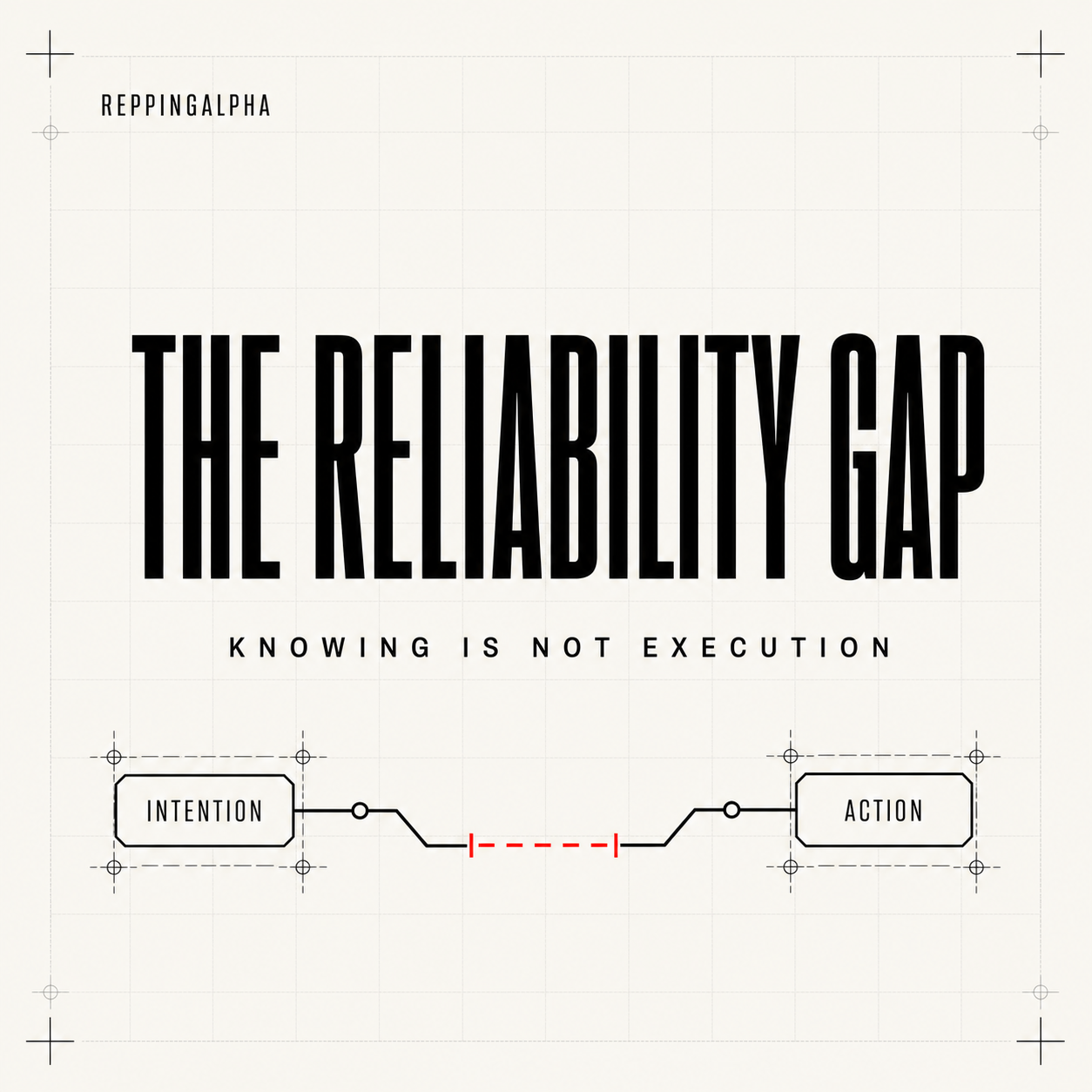
The Reliability Gap: Why Knowing What Matters Does Not Produce Action
Most people do not have an information problem. They know the project matters. They know the conversation needs to happen. They know the workout, the review, the recovery block, or the hour of focused work would improve their life.
Then the day closes and the important thing is still untouched.
That distance between clear intention and dependable action is the reliability gap. It is easy to misread the gap as laziness, weak discipline, or insufficient desire. Usually it is something more useful: evidence that the operating system surrounding the goal is incomplete.
AlphaProtocol begins there. The aim is not to make you feel more motivated. It is to build conditions in which meaningful action becomes easier to see, start, complete, and refine.
Knowing is not the same as being able to execute
A goal can be intellectually clear and operationally unavailable. “Build the business” may be important, but it does not tell you what to do at 9:10 on Tuesday morning. “Get healthy” may be sincere, but it competes poorly with an overloaded calendar, depleted energy, and an environment built for convenience.
When a goal remains abstract, your nervous system must repeatedly translate it into action under pressure. Every translation requires fresh judgment: What matters now? Where do I begin? How much is enough? What if I choose incorrectly? That hidden decision load is one reason apparently simple goals become unreliable.
A useful personal operating system — https://www.reppingalpha.com/blog/what-is-a-personal-operating-system-and-what-should-it-actually-do removes as many of those translations as possible before the moment of action.
The reliability gap has six common failure points
AlphaProtocol treats execution as a loop: Sense → Align → Structure → Execute → Circulate → Refine. The loop is not a motivational slogan. It is a diagnostic map. When action repeatedly fails, one or more parts of the loop usually contains the signal.
1. Sense: reality was never accurately read
You planned for the energy, time, and attention you hoped to have instead of the capacity you actually had. You missed a changed constraint, an unresolved emotion, or a competing obligation. The plan was obsolete before it began.
Friction signal: the same task keeps moving forward on the calendar without becoming easier to start.
2. Align: the action is disconnected from what matters now
A goal can remain worthy while its current expression becomes wrong. You may be protecting an old commitment, someone else’s definition of success, or a project whose cost now exceeds its value.
Friction signal: you can explain why the goal once mattered, but not why today’s action matters now.
3. Structure: the environment keeps winning
Attention follows cues. Behavior follows available paths. If the desired action requires twelve steps while distraction requires one tap, willpower is being asked to compensate for poor design.
Friction signal: you perform well on unusually calm days and collapse when the day becomes ordinary.
4. Execute: the next move is too large or vague
“Work on the proposal” is a category, not an action. “Open the proposal, write the decision paragraph, and send it to Maya by 11:00” has an entry point and a finish line. AlphaProtocol calls this the Next Rep: one useful action made clear enough to complete.
Friction signal: you keep preparing to begin but cannot describe what “done for today” looks like.
5. Circulate: completed action produces no useful return
A system weakens when effort disappears into a void. Evidence needs to circulate: a checked commitment, a visible result, a conversation, a lesson, or a signal that changes the next choice. Accountability should return information, not merely apply pressure.
Friction signal: you complete work but still feel as though nothing is moving.
6. Refine: the plan is defended instead of updated
Repeated friction is information. If the same plan fails three times, the question is not how to shame yourself into a fourth attempt. The question is what the pattern reveals about scope, timing, environment, capacity, or meaning.
Friction signal: each review produces a harsher promise but no change in design.
AlphaProtocol closes this gap with a daily ritual + DirectedAlpha heading. Start with Signal →
Why more motivation often makes the system worse
When the reliability gap appears, many people intensify the goal. They consume another podcast, rewrite the vision, raise the stakes, or promise a more disciplined Monday. This can create a temporary surge, but it also hides the actual constraint.
If the task is unclear, stronger desire does not make it clearer. If the environment is hostile, inspiration does not redesign it. If recovery is missing, urgency may borrow energy from tomorrow and deepen the failure pattern.
This is why a goal system should still work on low-motivation days — https://www.reppingalpha.com/blog/build-a-goal-system-that-still-works-on-low-motivation-days. Reliability is not the absence of difficult days. It is the ability to preserve the thread through them.
A same-day protocol for closing the gap
Choose one commitment that has slipped at least twice. Do not begin by recommitting. Run this short diagnostic instead.
• Name the observable miss. Write what did not happen without adding a character judgment. “I did not send the two outreach messages” is usable. “I am terrible at consistency” is not.
• Locate the break in the loop. Was the problem sensing, alignment, structure, execution, circulation, or refinement? Choose the earliest point that failed.
• Reduce the action to one Next Rep. Make it startable in under two minutes and finishable inside a defined block.
• Change one condition. Move the phone, close the door, prepare the document, shorten the block, schedule recovery, or ask for the missing decision.
• Return evidence. Record what happened and what the result changes. The purpose is not to preserve a streak. It is to improve the system.
For example, “finish the launch plan” may become: “At 9:00, open the launch document, write the three unresolved decisions, and send them to the owner before 9:25.” The smaller action is not a retreat from ambition. It is the unit through which ambition becomes real.
Review without turning evidence into identity
A reliable system separates the person from the pattern. You are not the missed block, the abandoned week, or the badly designed routine. Those events are data about a system operating under specific conditions.
A useful review asks:
• What actually happened?
• Where did the loop break first?
• What condition helped or hindered execution?
• What is the smallest correction worth protecting next?
This is the foundation of reviewing goals without self-judgment — https://www.reppingalpha.com/blog/how-to-review-your-goals-without-turning-the-review-into-self-judgment. Constructive interpretation is not forced positivity. It is disciplined accuracy: neither excusing the miss nor turning it into a verdict.
Reliability is built by preserving the thread
The deepest cost of inconsistency is not a missed task. It is losing contact with the work long enough that returning becomes psychologically expensive. The system must therefore protect continuity before intensity.
One honest check-in, one reduced action, or one deliberate recovery decision can preserve the thread. That continuity keeps the goal available for refinement instead of forcing a dramatic restart.
If you fall away entirely, use the six-step process for returning to your goal system — https://www.reppingalpha.com/blog/how-to-return-to-your-goal-system-after-you-fall-off. The return is not evidence that the system failed. A clean return path is part of a complete system.
The operating question
When you know what matters but do not act, do not ask only, “Why am I not more disciplined?” Ask a better sequence:
What is happening? What matters now? What conditions would help? What is the Next Rep? What evidence returned? What changes next?
That sequence turns a moral judgment into an operating diagnosis. It closes the reliability gap one useful correction at a time.