How to Review Your Goals Without Turning the Review Into Self-Judgment
By Eric, Founder of ReppingAlpha | Last updated August 7, 2026
A review should make the next decision better.
If your weekly review is only a list of everything you failed to finish, it is not a control system. It is an emotional retrospective.
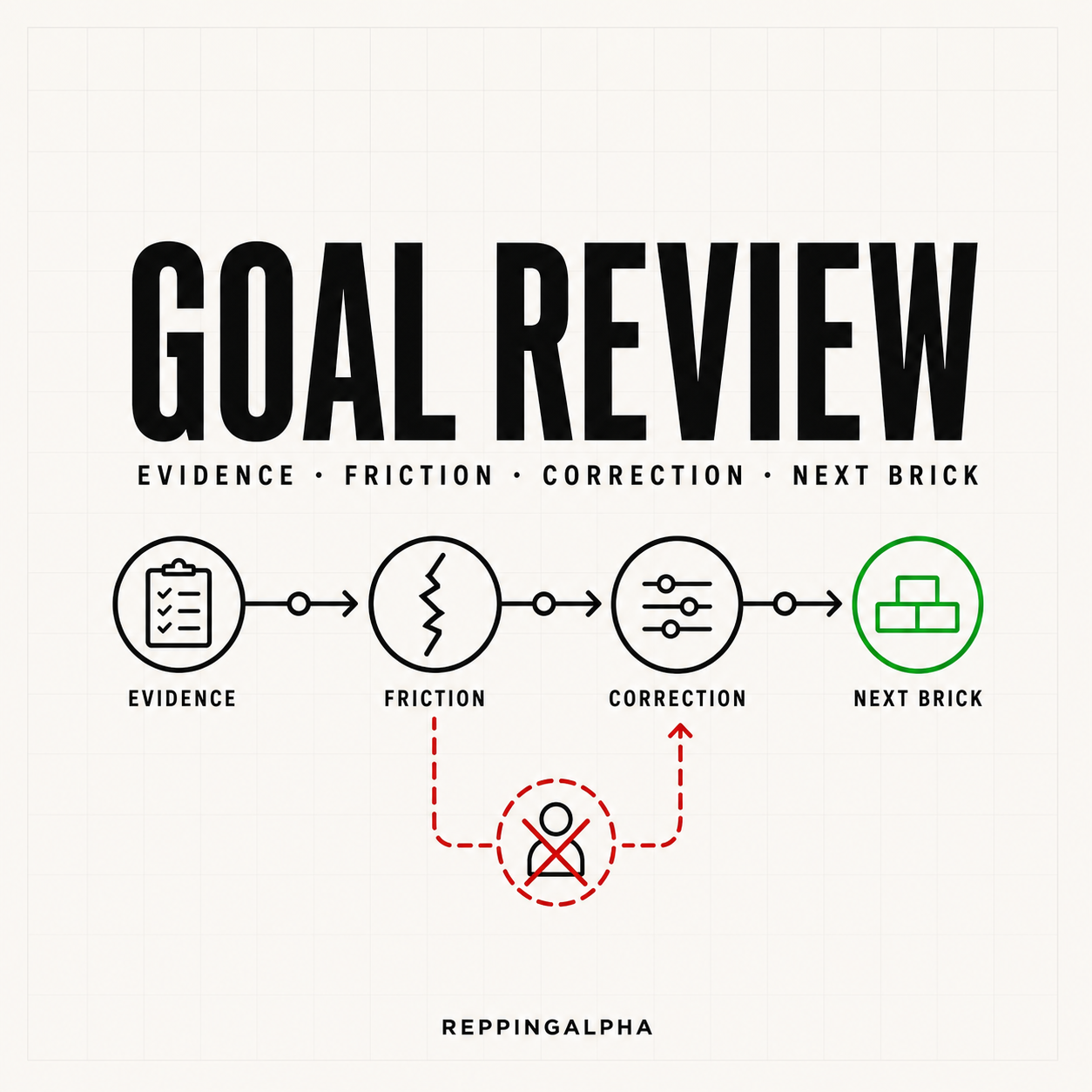
ReppingAlpha uses review to close the loop: action produces evidence, evidence improves structure, and structure shapes the next action.
Review in the right order
Use this sequence:
Purpose → State → Action → Evidence → Friction → Outcome → Learning → Correction
The order matters because lagging outcomes alone can hide useful information.
For example, you may have completed every planned outreach block while the result remained flat. That suggests a different problem than missing every block. The first calls for examining quality, strategy, audience, or assumptions. The second calls for examining execution conditions.
The weekly review
Keep it short enough to repeat.
Direction
What is the primary outcome for this season?
Did my calendar reflect it?
Leading evidence
Which behaviors under my control happened?
How many protected blocks were completed?
Quality
What signal shows whether the work was good enough?
Friction
Where did I stall?
Was the likely category unclear, conflict, threat, capability, friction, or depletion?
Result
What changed in the actual outcome?
Correction
What one variable will I change next week?
Next Rep
What is the first evidence-producing action already placed on the calendar?
The review stays cleaner when the heading itself is current. DirectedAlpha is the living record the weekly review tests against — if the edge no longer pulls, you recalibrate it instead of judging the week. See DirectedAlpha →
The monthly review
Zoom out enough to see repeated patterns.
Ask:
Which behavior has become easier because the rhythm repeated?
Which failure point returns despite recommitment?
Is the goal still worth the capacity it consumes?
Does the environment support the current season?
What is happening to health, relationships, and recovery while the goal advances?
Which assumption needs a real test?
Do not change five variables at once. You will lose the ability to learn which change mattered.
The quarterly review
The quarterly review is allowed to question the architecture itself.
Does this goal still belong in my life now?
What proof exists that was not available 90 days ago?
What changed in responsibilities, constraints, identity, or ambition?
What should continue, strengthen, sequence, or stop?
What does the next season require?
Recalibration is one of the differences between a living system and a rigid planner.
Quarterly recalibration is built into the higher tiers so the architecture itself gets reviewed, not only the week’s evidence. Compare Signal, Coherence, and Resonance →
Never use a miss as evidence of identity
“I missed three workouts” is data.
“I am undisciplined” is a story.
The story can feel efficient because it explains everything at once. It also gives you almost nothing useful to redesign.
Stay with evidence long enough to find the lever.
The two questions that keep review honest
What evidence supports my current interpretation?
What evidence challenges it?
Those questions protect review from becoming either self-attack or self-congratulation.
A worked weekly review
Suppose the 90-day goal is to complete a first manuscript draft.
Purpose: produce a complete draft that can be edited, not a perfect first version.
Leading evidence: four 60-minute writing blocks planned; three completed.
Quality: the completed blocks produced 3,200 usable words.
Friction: Thursday’s block started 25 minutes late because email remained open after a meeting.
Outcome: manuscript moved from 18,000 to 21,200 words.
Interpretation: the system is working; one transition between meetings and writing is weak.
Correction: close communication apps at the end of the meeting and add a five-minute reset before writing.
Next Rep: Monday 8:30–9:30, draft the next scene; document open beforehand.
That review produces a targeted correction. “Try to be more disciplined next week” does not.
Four review mistakes to avoid
Reviewing only lagging results
Outcome measures matter, but they arrive late. Pair them with behaviors you can change sooner.
Changing everything after one bad week
One unusual week may not reveal a stable problem. Change the clearest variable first and keep collecting evidence.
Protecting the plan from the evidence
If the strategy repeatedly fails despite clean execution, loyalty to the original plan is not discipline. Revisit the assumptions.
Letting the review become administration
The purpose is a better next decision. If the template grows faster than the work, simplify it.
Next step: Coherence adds monthly and quarterly recalibration to the daily AlphaProtocol rhythm. For personalized phase reviews and priority accountability, see Resonance.
This post is part of the Personal Operating System pillar of AlphaProtocol — see the full framework for turning review into structural improvement.