What a Useful Goal Accountability System Should Actually Do
By Eric, Founder of ReppingAlpha | Last updated August 7, 2026
Accountability is often reduced to “someone checking on you.” That is too shallow.
A useful accountability system makes the commitment visible, detects drift early, creates an honest review point, and helps convert a miss into a specific correction.
Its purpose is not surveillance, shame, or borrowed motivation. Its purpose is continuity.
The four layers of accountability
Layer 1: Self-visible commitment
Write the goal, proof, deadline, protected capacity, and next action. A commitment that exists only in memory is easy to renegotiate invisibly.
Layer 2: Cues and reminders
Use reminders sparingly. A reminder should reconnect you to an already chosen action, not become another stream of noise.
Layer 3: Evidence review
Review leading behavior and outcomes on a fixed cadence. The question is not “Were you good?” It is “What happened, what did it produce, and what changes next?”
Layer 4: Human accountability
Another person can notice patterns you normalize, challenge an interpretation, ask for the evidence, or intervene when participation drops.
Human accountability becomes more useful as goals become complex, stakes rise, blind spots matter, or the cost of silent drift increases.
What accountability should not do
Good accountability should not:
humiliate you for a miss;
pretend every obstacle is resistance to be bulldozed;
substitute the accountability partner’s goals for yours;
create dependence on constant encouragement;
make therapeutic or medical claims unless delivered by appropriately qualified professionals;
reward performative busyness over real evidence.
The accountability conversation
When execution breaks, use five questions:
What was the exact commitment?
What happened in observable terms?
What category best explains the break—clarity, conflict, threat, capability, friction, or depletion?
What is the smallest structural correction?
What evidence will we review next, and when?
This turns accountability into diagnosis plus action.
Match the accountability layer to the problem
Use the lightest layer that actually closes the gap.
Forgetting the ritual — cue/reminder: make the chosen action visible at the right time.
Inconsistent self-review — fixed scorecard/review: force evidence into view on a cadence.
Repeating the same rationalization — accountability partner: ask the question you keep avoiding.
Strategy or life phase keeps changing — calibrated human review: challenge assumptions and redesign the system.
High cost of silent drift — priority accountability: detect missed participation and create direct follow-up.
The table is a diagnostic, not a hierarchy of moral seriousness. Needing human accountability does not mean you have less discipline; it may mean the system benefits from an external feedback loop.
A useful check-in is short and evidence-based
A 10-minute accountability check can use this sequence:
Commitment: what did you say would happen?
Evidence: what actually happened?
Diagnosis: what helped or blocked execution?
Decision: what stays and what changes?
Next proof: what will exist by the next check-in?
The accountability partner does not need to deliver a speech. The structure should make reality hard to hide and the next action easy to name.
When self-accountability may be enough
If the goal is clear, the consequences are modest, the behavior is already stable, and you reliably review your own evidence, a written system may be sufficient.
When another person may help
Consider a human layer when:
you repeatedly make the same promise and silently abandon it;
the goal has high personal or professional consequences;
you need outside challenge on assumptions;
changing life conditions require frequent recalibration;
isolation makes it easy to rationalize drift.
More support is not inherently better. Use the smallest level that solves the problem.
How AlphaProtocol handles accountability
Signal begins with the daily written ritual, reminders, milestone reassessment, and an accountability agreement. Coherence adds a deeper system plus more frequent review. Resonance adds personal calibration and priority human accountability for people who want the system actively held with them.
The agreement only closes the loop around something current. DirectedAlpha is the living record the accountability structure protects — so outreach is about a real edge, not a goal that has already gone stale. See DirectedAlpha →
The progression matters: accountability should sit around a clear operating system, not replace one.
The difference across Signal, Coherence, and Resonance is how much of the accountability structure is held for you versus held by you. Compare the tiers →
Next step: Compare Signal, Coherence, and Resonance. If you want the highest-touch layer, see Resonance or contact ReppingAlpha.
This post is part of the Follow-Through pillar of AlphaProtocol — see the full framework for building accountability that survives a bad week.
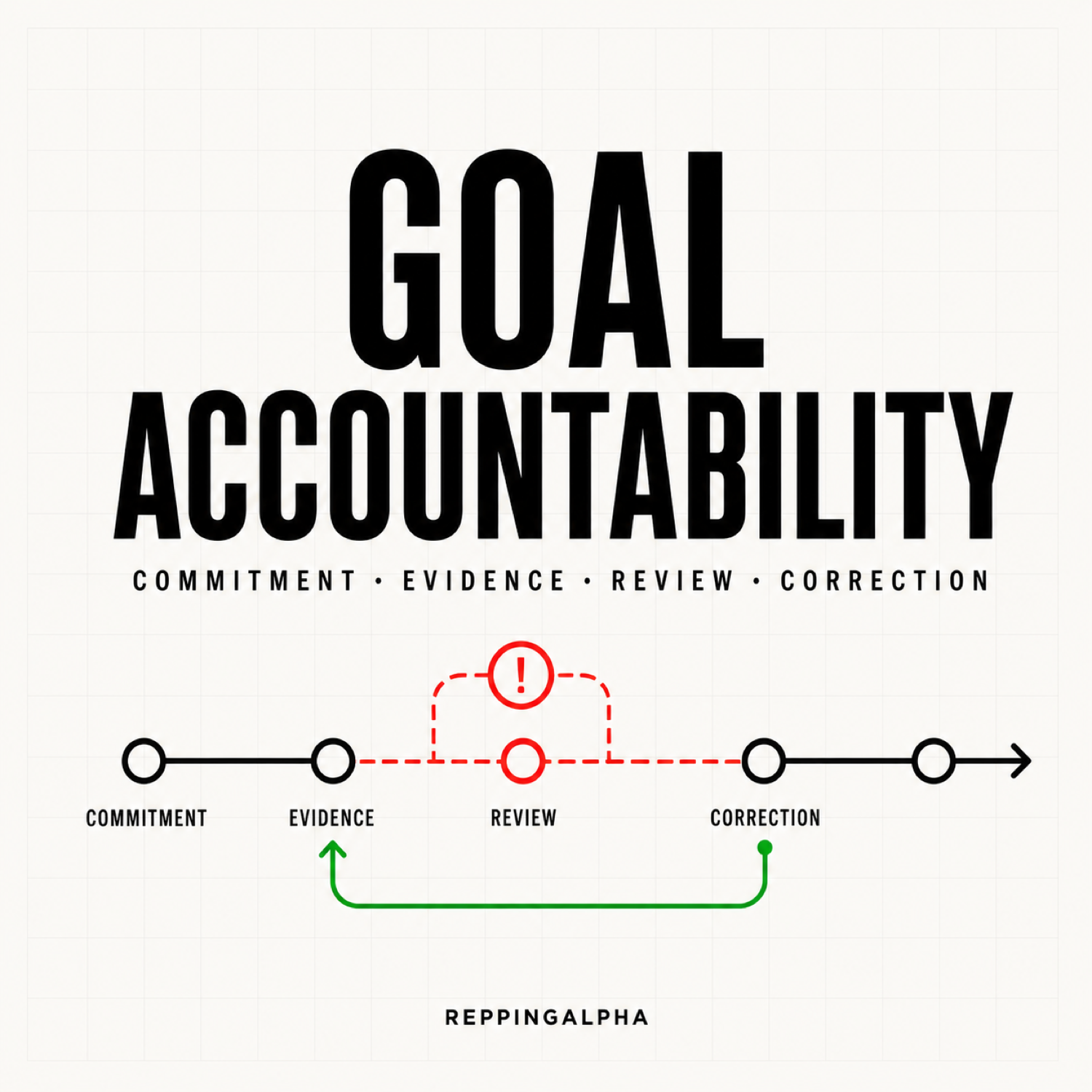
Accountability feedback loop connecting commitment, evidence, review, and correction.