Sense Is Not a Step: The Diagnostic Stance Behind AlphaProtocol
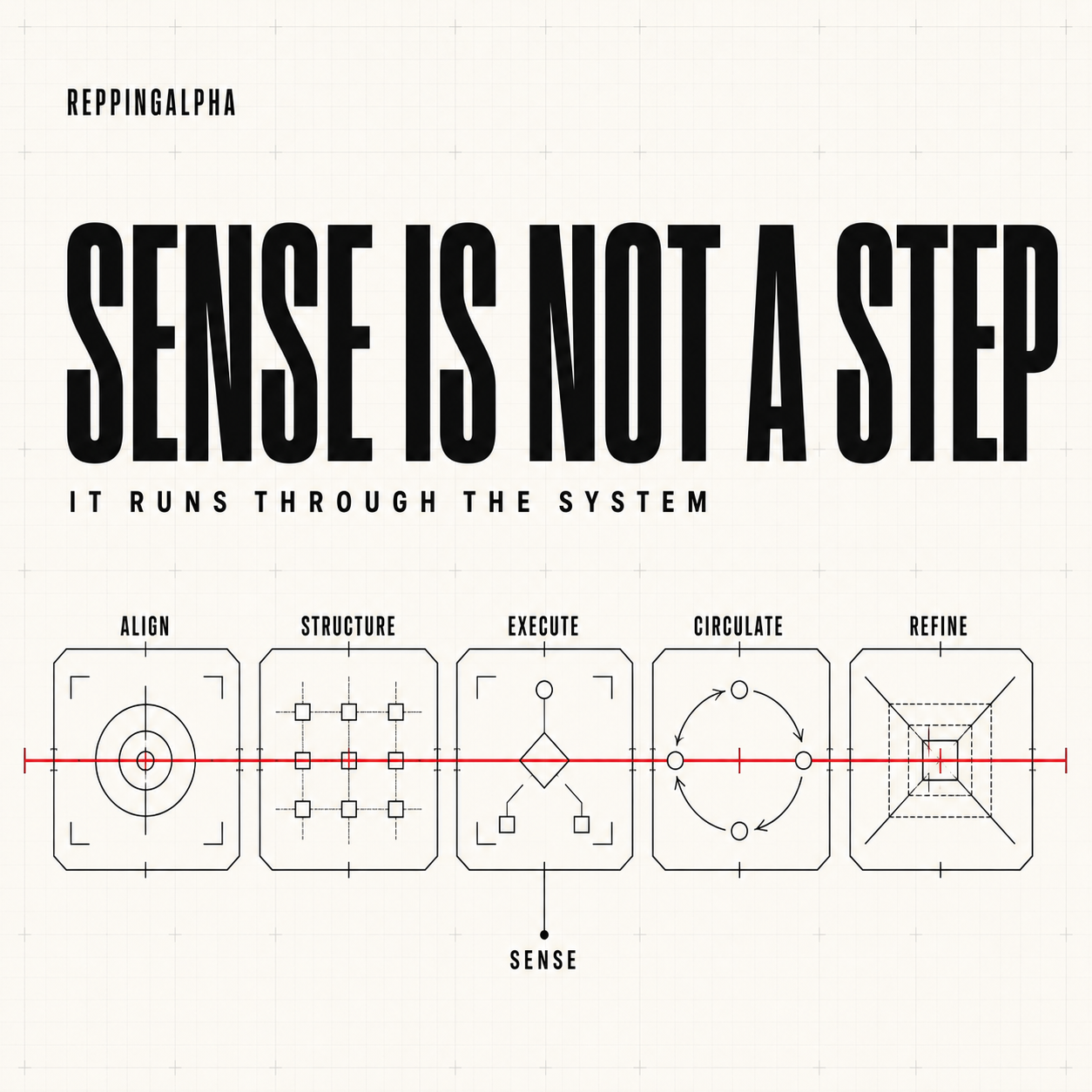
The AlphaProtocol cycle is often drawn as Sense → Align → Structure → Execute → Circulate → Refine. Read too literally, that diagram creates a problem: it makes Sense look like a box you check before moving on.
That is not how Sense works.
Sense is the ongoing stance that keeps every other part of the system in contact with reality. It is attention before commitment, during action, and after the result returns. Without it, alignment becomes ideology, structure becomes rigidity, execution becomes force, circulation becomes noise, and refinement becomes cosmetic.
Sense is not one more productivity technique. It is the discipline of noticing what the system is actually doing.
The difference between observation and interpretation
A useful system separates the observable event from the story attached to it.
Observation: I postponed the proposal block three times.
Interpretation: I must not want this enough.
Observation: My energy drops sharply after 2:00 PM.
Interpretation: I should be more disciplined.
Observation: The same conversation produces confusion every week.
Interpretation: They never listen.
The interpretation may contain part of the truth, but it arrives too early. Premature interpretation closes the investigation. Sense keeps it open long enough to collect evidence.
This is why constructive interpretation matters. The practice is not positive thinking. It is a refusal to convert incomplete evidence into a final verdict. See https://www.reppingalpha.com/blog/positive-thinking-is-not-enough-use-constructive-interpretation-instead
Sense inside Align
Alignment asks, “What matters now?” Sense prevents the answer from becoming ceremonial.
A goal may still sound meaningful while no longer fitting the season, the available capacity, or the problem that actually needs attention. Sensing alignment means noticing where language and behavior diverge.
Diagnostic questions:
• What do I keep saying matters but repeatedly refuse to protect?
• What am I protecting automatically, without needing motivation?
• Has the goal changed, or only my willingness to admit it?
• What cost am I excluding from the decision?
The point is not to abandon difficult goals whenever resistance appears. It is to distinguish the resistance of growth from the resistance of misalignment.
Align is where Sense meets the current edge. The DirectedAlpha heading is the reference point the resonance scan tests against — if the heading no longer pulls, you recalibrate the edge instead of adding pressure. See DirectedAlpha →
Sense inside Structure
Structure asks, “What conditions help?” Sense makes those conditions observable.
Most environments are judged by intention: the calendar looks organized, the phone is face down, the plan seems reasonable. A sensed environment is judged by what behavior it reliably produces.
If a routine works only after excellent sleep, an interruption-free morning, and unusual enthusiasm, it is not yet reliable. If a digital boundary collapses each evening, the repeated collapse is not an exception. It is the current design.
The practical move is to inspect friction without moral drama:
• Where does the desired action slow down?
• Which cue starts the unwanted sequence?
• What preparation is repeatedly missing?
• Which decision could be removed in advance?
Habit architecture becomes useful when it follows those signals rather than copying someone else’s routine. See https://www.reppingalpha.com/blog/habit-architecture-build-better-habits-and-break-bad-ones-without-a-willpower-contest
Sense inside Execute
Execution asks, “What is the Next Rep?” Sense keeps that rep proportional to reality.
A Next Rep is not simply a small task. It is the next action that is both useful and executable under current conditions. Too small, and it becomes motion without progress. Too large, and it becomes another abstract command.
Before acting, sense three things:
1. Capacity: What can be completed cleanly in the available time and energy?
2. Dependency: What decision, person, or material must be present first?
3. Finish line: What visible state will tell me this rep has been completed?
During action, Sense notices when the work reveals a different problem. That is not permission to chase every distraction. It is permission to update the map when evidence changes.
The reliability gap often begins here: people know what matters but have not translated it into a rep the current moment can support. Read the full diagnostic at https://www.reppingalpha.com/blog/the-reliability-gap
Sense inside Circulate
Circulation asks, “What returned?” Sense distinguishes signal from applause.
Not every response is useful. Praise may feel good while hiding weak results. Discomfort may feel bad while revealing a necessary correction. A metric may be precise while measuring the wrong thing.
Useful circulation returns evidence that can change the next decision:
• Did the action produce the intended effect?
• What changed in the environment?
• What response came from other people?
• What pattern repeated?
• What did the action cost in attention, energy, or trust?
Accountability is strongest when it helps information circulate. It should not merely ask whether you complied. It should improve the quality of the next choice. See https://www.reppingalpha.com/blog/what-a-useful-goal-accountability-system-should-actually-do
Sense inside Refine
Refinement asks, “What changes next?” Sense prevents the review from becoming either self-defense or self-punishment.
A weak review asks whether you were good enough. A sensed review asks what the evidence permits you to change.
The correction may be to reduce scope, move the work, redesign a cue, ask for help, protect recovery, or stop a commitment that no longer earns its cost. It may also be to hold the line because the system is working and discomfort is part of the adaptation.
The key is specificity. “Try harder” is not a refinement. “Move the writing block before email and prepare the document the night before” is.
For a review process that separates evidence from identity, see https://www.reppingalpha.com/blog/how-to-review-your-goals-without-turning-the-review-into-self-judgment
A six-question sensing practice
Use these questions at the start or end of any meaningful work cycle:
1. What is happening—not what should be happening?
2. What matters now—not what mattered by default?
3. What condition is shaping the behavior?
4. What action is actually available?
5. What evidence returned?
6. What does that evidence change?
Write short answers. The purpose is not to create a journal entry. It is to prevent the operating system from drifting away from lived conditions.
Sense keeps the system honest. The daily ritual and the three support levels turn that honesty into a repeatable practice instead of an occasional insight. Compare the tiers →
Why Sense has no separate set of principles
In AlphaProtocol, Sense does not need its own isolated category because it runs through every principle. “Systems Over Willpower” requires sensing the conditions that shape behavior. “The Micro Reveals the Macro” requires sensing small repetitions. “Follow the Evidence” is Sense converted into a decision rule.
Treating Sense as a separate phase would imply that observation ends when action begins. In a living system, observation continues. Every stage is both action and feedback.
The stance can be summarized in one instruction:
Do not defend the plan from reality. Use reality to improve the plan.
That is Sense. It is how the protocol stays alive rather than becoming another set of rules to obey.